
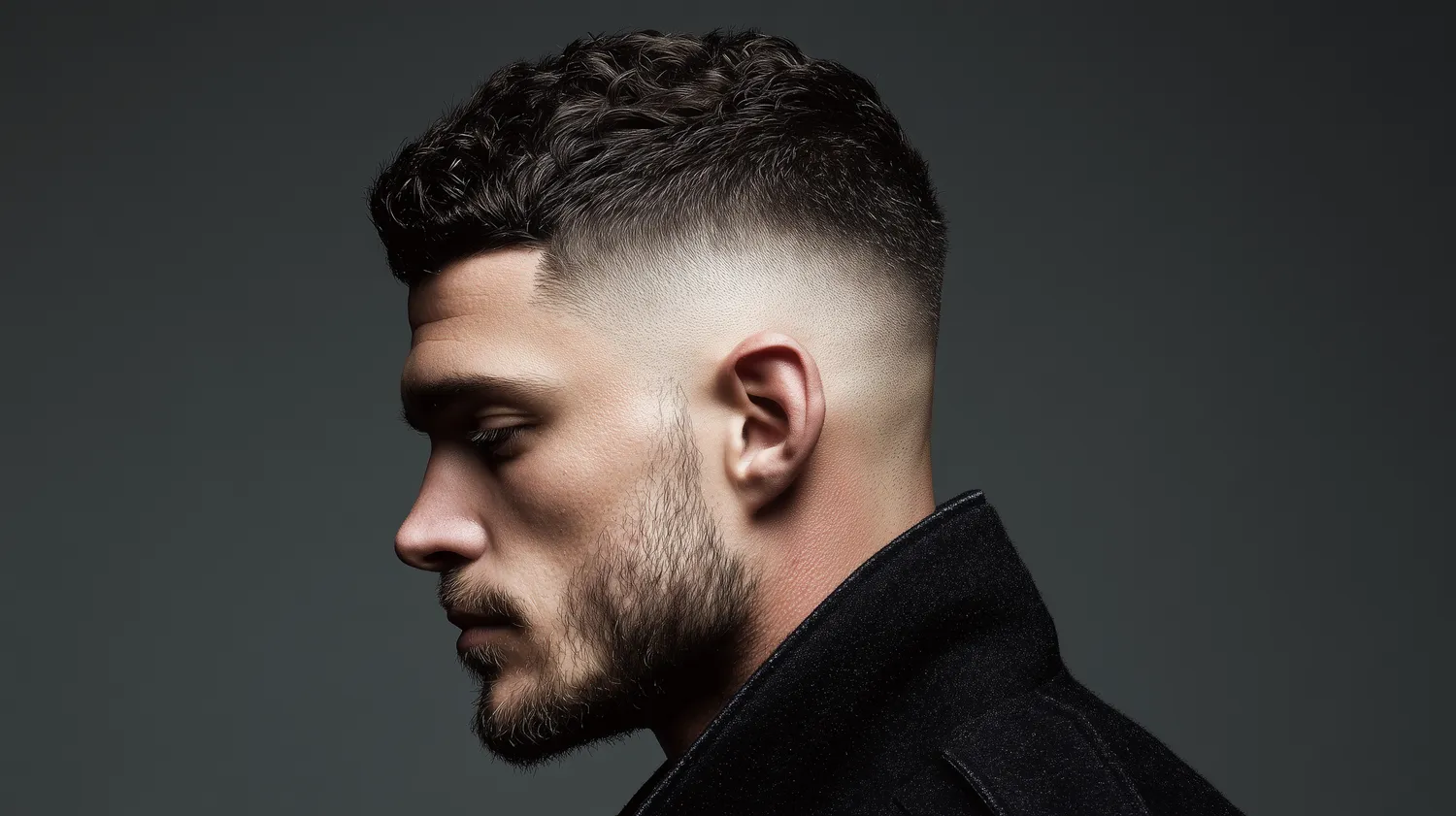
Low, Mid, or High Fade – How to Know Which One You Actually Want
Most guys who sit down in the chair and ask for “a fade” have a picture in their head and no vocabulary to describe it. Then they get something technically clean that looks nothing like what they wanted, decide the barber got it wrong, and repeat the process somewhere else.
The fix is one sentence long. A fade has two independent measurements, and once you know both, you can order the haircut you actually want — here, or anywhere.
The Thing Almost Nobody Explains
Height and depth are separate decisions.
Height is what “low,” “mid,” and “high” refer to. It means how far up your head the shortest hair travels — where the gradient starts and where it finishes.
Depth is how short the shortest part goes. Skin (also called a bald fade), or a #0.5, or a #1 — hair left, just very short. This is a completely different question from height.
That means a low skin fade and a high taper fade both exist, and they look nothing alike. When a guy says “I got a low fade and it came out way too aggressive,” what he usually means is that the depth was skin when he wanted a #1. The height was fine. If you only communicate one of the two numbers, your barber has to guess the other one.
Say both. “Low fade, down to a #1, blended up into about two inches on top” is a complete instruction. “A fade” is not.
Where the Three Heights Actually Sit
Fades are described relative to landmarks on your skull, not in inches. Put your hand flat on the side of your head and run it upward — you will feel the point where the side of your head stops going straight up and starts curving over toward the top. That corner is the parietal ridge, and it is the single most important landmark in this entire conversation. Every fade height is defined by its relationship to it.
Low Fade
The gradient starts roughly an inch above the hairline and finishes below your temples. It follows the natural perimeter of your head — around the ears, down behind them, along the nape — and stays in the lower third of the side of your head.
Visually, a low fade keeps hair mass at your temples and above your ears. It reads conservative, classic, understated. It is the fade most people would not identify as a fade at all; they would just say your hair looks sharp.
Mid Fade
The gradient begins around temple level, somewhere between the top of your ear and the parietal ridge. It is the middle of the road in every sense: it takes some visual weight off the sides without exposing the upper portion of your head.
This is the most versatile of the three and the safest choice when you genuinely do not know. If you brought a photo and cannot tell which height it is, it is a mid fade about 60% of the time.
High Fade
The gradient begins at or above the parietal ridge, taking the short work up into the widest part of your head and often right up to the temple corners.
A high fade removes weight at the point where your head is widest. That is a strong visual effect: it makes the head look narrower and taller, and it creates a sharp separation between the sides and whatever length is left on top. It reads bold, modern, deliberate. Nobody mistakes a high fade for “just a neat haircut.”
And Two Terms That Are Not Heights
Taper is not a fade height — it is a smaller haircut altogether. A taper is confined to the perimeter: the sideburns and the nape, blended short at the very edges, with the rest of the sides left at a single length. If you want the most conservative option that exists, you want a taper, not a low fade.
Burst fade and drop fade describe the shape of the fade line rather than its height. A burst fade arcs in a semicircle around the ear and does not continue up the back. A drop fade curves down behind the ear toward the nape instead of running level. Either can be low, mid, or high.
Clipper Numbers, So You Can Speak in Specifics
The depth half of the instruction is easiest to communicate in guard numbers.
| Guard | Length | What it looks like |
| Foil shaver / zero | Skin | No visible hair; scalp showing |
| #0 | 1/16″ (1.5 mm) | A shadow of hair; not quite skin |
| #0.5 | 3/32″ (2.5 mm) | Very short, clearly still hair |
| #1 | 1/8″ (3 mm) | Short, dark, holds colour |
| #1.5 | 3/16″ (5 mm) | Noticeably softer edge |
| #2 | 1/4″ (6 mm) | Short but with some substance |
| #3 | 3/8″ (10 mm) | Standard “short back and sides” |
| #4 | 1/2″ (13 mm) | Moderate length; combable |
| #5–#6 | 5/8″–3/4″ (16–19 mm) | Long enough to have shape |
| #7–#8 | 7/8″–1″ (22–25 mm) | Approaching the shortest “top” lengths |
A fade is built by working up through consecutive guards and then blending out the lines between them, usually with a lever adjustment and finishing shears. “Skin fade” means the bottom of that stack is a foil shaver. “Shadow fade” or “taper fade” means the bottom of the stack still has hair in it.
How to Choose: Seven Factors That Actually Decide It
The internet answers this question with face shapes and stops there. Face shape matters — but it is one of seven things, and it is not the most important one.
1. Your Hairline, and Whether It Is Receding
This is the factor that overrides everything else, and it is the one guys most often ignore.
A high fade takes hair away from your temple corners — precisely where recession happens. If you have any temple recession at all, a high fade brings the fade line and your hairline together, and the two read as one large area of exposed scalp. The haircut does not hide the recession; it frames it.
If your hairline is receding, keep density at the temples. That means a low fade, or a mid at most, and probably not to skin. A low fade preserves the hair around your temple corners and keeps the boundary between “haircut” and “hairline” soft rather than sharp.
If your hairline is intact and strong, a high fade will look excellent on it — it is one of the more flattering things you can do with a good hairline.
2. Density on Top
Contrast is the enemy of a thinning crown.
A high skin fade creates the maximum possible contrast between the sides and the top. If the top is dense, that contrast reads as intentional and sharp. If the top is thinning, the same contrast makes the sparse area look sparser — the eye compares the thin top against the bare sides and registers the difference.
For thinning on top, reduce contrast: a low fade, not to skin, with the top kept short enough that density reads as uniform. If you are further along than that, the honest answer is that a very short overall cut with a low taper often looks dramatically better than any fade — and any barber worth going to will tell you so rather than sell you a haircut that highlights the problem.
3. Head Shape and the Parietal Ridge
Now the geometry.
A high fade removes visual weight at the widest point of your head, which narrows and heightens the head’s apparent shape. A low fade retains that weight, keeping the head looking wider and rounder. So:
- Round or wide head and face — mid or high fade. Taking bulk off the sides adds vertical line. Pair it with some height on top; a high fade with a flat, short top on a round head just emphasises the roundness.
- Long or oblong face — low fade. You do not want more vertical emphasis. Keeping weight at the sides balances the length of the face.
- Square jaw — mid fade is the natural match, and it is hard to go wrong. A strong jawline supports a sharper fade without needing help.
- Diamond, or wide cheekbones with a narrower forehead — low fade. Taking hair off the temples exposes the widest part of the face; keeping it softens the transition.
- Heart shape, wider forehead — low or mid, with some weight left in the fringe area rather than taken up high.
If you want to go deeper on this half of the decision, we have a separate guide to choosing a men’s haircut that fits your face shape — the fade is only one component of the overall shape.
4. Ears
Underrated and worth thirty seconds of thought. A high fade fully exposes the ears and draws the eye to them, because it strips away everything around them. If your ears stick out and you would rather they did not, a low fade leaves hair at ear level and softens the outline considerably.
5. Scalp Condition
Skin fades show the scalp, and therefore everything on it — scars, moles, birthmarks, uneven pigmentation, the shape of the skull itself. The higher the fade, the more scalp is on display.
This is not an argument against skin fades. It is an argument for looking at your own head in a mirror with the sides pressed flat before committing, and for choosing a #0.5 or #1 instead of skin if there is something up there you would rather leave covered.
6. Length on Top — the Ratio Nobody Discusses
Fade height and top length have to be chosen together, because the relationship between them is what determines the look.
| Fade height | Short top | Medium top | Long top |
| Low | Clean, conservative, low-key | Classic; the default sharp haircut | Traditional; slick-back and side-part territory |
| Mid | Neat and modern | The most reliable combination there is | Strong shape without severity |
| High | Severe; reads military | Bold and current | Maximum contrast; a statement |
If you want a specific look, describe the combination rather than one half of it. “High fade” with no length instruction produces a coin flip between “sharp and modern” and “boot camp.”
7. How Often You Actually Get Cut
This is the practical factor, and it is where most fade regret comes from.
A fade is a gradient, and gradients grow out unevenly. The shortest area grows fastest in visual terms — a skin fade goes from bare to fuzzy in a few days, and the crisp line at the top of the gradient softens, then blurs.
Realistically:
- High skin fade — genuinely crisp for about five to seven days, presentable for around two weeks, wants a cut every two to three weeks
- Mid fade — holds well for three to four weeks
- Low fade or low taper fade — looks intentional for four to six weeks and grows out gracefully rather than falling apart
If you get cut every six weeks and you ask for a high skin fade, you will spend most of your life with a haircut that is past its best. That is not the barber’s fault and it is not the haircut’s fault. Match the fade to your actual schedule, not your aspirational one.
If a high fade is what you want and you cannot reliably get in every two to three weeks, say that out loud when you book. There is usually a version of the cut — a slightly lower start point, a #0.5 instead of skin at the bottom — that gets you most of the look with double the lifespan.
The Quick Answer Table
| If this is you | Start here |
| No idea, just want to look sharp | Mid fade, #1 at the bottom |
| Receding at the temples | Low fade, not to skin |
| Thinning on top | Low fade, low contrast, short top |
| Round or wide face | Mid or high fade with height on top |
| Long or narrow face | Low fade |
| Prominent ears | Low fade |
| Corporate or conservative workplace | Low fade or a taper |
| Want maximum sharpness, get cut every two weeks | High skin fade |
| Get cut every six weeks | Low taper fade |
| Thick, dense, coarse hair | Any of the three; high fades look outstanding on it |
| Fine hair | Low or mid, and skip the skin |
| Curly or coily hair | Mid fade, and discuss shrinkage before anything is cut |
| Full beard | Low or mid, blended into the beard — see below |
If You Have a Beard, the Fade Height Is Not Just About Your Hair
This gets missed constantly, and it changes the answer.
Your sideburns are the junction between your haircut and your beard. Fade height determines how much room there is to make that junction work.
- A low fade with a full beard gives the most natural result. The gradient sits low enough that the sideburn can carry hair length down into the beard, and the two connect as one continuous shape. This is the classic barbershop look, and it is the most forgiving.
- A mid fade with a beard still connects, but the transition has to be handled deliberately — the fade needs to arrive at the sideburn at a length that the beard can pick up from.
- A high fade with a full beard produces a hard disconnect: short sides meeting a dense beard with nothing in between. That can look excellent and very intentional, but it is a specific choice rather than a default, and it looks wrong if it happens by accident.
If you wear a beard, ask for the haircut and the beard trim as one job rather than two. The line where they meet is where a good barber earns their money, and it cannot be done well if the beard is shaped without reference to the fade.
Curly and Coily Hair: One Extra Consideration
If your hair has significant curl, the length that comes off the clipper is not the length you see. Coily hair can shrink to a fraction of its actual length once it dries and springs back, so a guard number that looks right on straight hair reads much shorter on yours.
Two practical consequences. First, the contrast between a faded side and a curly top is naturally higher than it is on straight hair, which means a mid fade on curls often delivers the visual impact of a high fade on straight hair. Second, the blend has to be cut with the curl pattern in mind rather than against it — a skill question, not a preference question. Look through a shop’s gallery for work on hair like yours before your first cut there.
How to Ask For It, in Order
Say these six things and you will get what you pictured.
- Height, with a landmark. “Low — keep it below my temples.” Or point: “Start the fade about here.” Landmarks beat adjectives.
- Depth, with a number. “Down to a #1,” or “skin at the bottom.” This is the half everyone forgets.
- Top length, in inches or in what you want to do with it. “Leave about two inches, I comb it back” is more useful than a number alone, because it tells your barber what the cut has to be able to do.
- Blended or disconnected. Blended means the top flows into the fade. Disconnected means there is a deliberate break between them. Very different haircuts.
- Nape shape. Blocked (a straight line), rounded, or tapered/natural. Tapered grows out best. Blocked looks sharpest for about a week.
- What you don’t want. “Don’t take the sideburns above my ear,” or “don’t line up my hairline, I want it natural,” saves more haircuts than any positive instruction.
And bring two photos — front and side. The side photo is the one that matters for a fade, and it is the one almost nobody brings. A front-facing photo tells your barber almost nothing about fade height.
Three Mistakes Worth Avoiding
Asking for the fade you saw on someone with different hair. A high skin fade on a guy with dense, coarse, straight hair and an intact hairline is not a haircut you can order — it is a haircut he can wear. The reference photo is useful as a direction, not a specification.
Going higher every visit. It creeps. Each cut takes the line up a little to blend out the previous growth, and eight months later you are wearing a high fade you never chose. If you want to stay low, say so every time.
Going straight to skin on a first visit to a new shop. Skin is unforgiving of both scalp irregularities and blending errors. Start at a #0.5 or #1, see how the work looks on your head, then go shorter next time if you want to. You can always take more off; you cannot put it back.
Chicago-Specific: Beanie Season Is Real
Six months of the year a hat is on your head most of the time you are outside, and it affects fades in ways worth planning around.
Compression blurs a gradient. A knit hat pressed over a high skin fade for eight hours flattens the transition and roughs up the shortest section. A high fade in February looks less crisp on day four than the same cut looks in July. If you wear a beanie daily and you want the haircut to hold, a low or mid fade is the more sensible choice from November through March.
Exposed scalp gets dry here. Chicago winter air plus indoor heating is aggressive on skin, and a skin fade means a large area of newly bared scalp with nothing protecting it. Flaking on a freshly faded head is very common in January, and it is usually dryness rather than dandruff. A light moisturiser or scalp oil on the faded area — not just on the hair — solves it.
Lakefront wind is a real constraint on the top, not the sides. If you walk to the Red Line every morning, a top length that only looks right when it is perfectly placed will not survive the walk. Either go shorter on top or use a product with enough hold to hold.
Summer humidity works the other way. Whatever length you leave on top will move, expand, and stop holding its shape in July. A cut that relies on a precise top shape needs a product that can handle humidity, or a shorter top through the summer.
After the Cut: Keeping It Sharp
The faded sides need essentially nothing. Everything you do at home is about the top.
- Wash less than you think. Every other day is enough for most guys; daily washing strips the oils that keep the top workable.
- Dry it before you style it. Thirty to sixty seconds with a dryer, pushing the hair in the direction you want it to sit, does more for the finished look than any product. Styling soaking-wet hair is the main reason your hair never looks the way it did in the chair.
- Match the product to the finish. Clay and matte paste for texture and a natural look, pomade for shine and control, cream for softness and minimal hold. Most guys use too much of the wrong one.
- Moisturise the faded area in winter, as above.
- Book before you leave. With a fade specifically, the calendar is the maintenance plan. A high fade wants two to three weeks; a low taper can go four to six.
Not Sure? That Is a Conversation, Not a Guess
The honest version of this article is that a good barber will look at your hairline, feel where your parietal ridge sits, ask what you do for work and how often you can get in, and then tell you which of the three to get. That takes about ninety seconds, and it is part of the haircut.
At Artur’s Barber Shop on Bryn Mawr in Edgewater, we cut low fades, mid fades, high fades and skin fades every day, alongside traditional scissor work and hot lather razor shaves. If you want to talk the decision through before anything gets cut, say so when you sit down — we would much rather spend two minutes on it than have you leave with a technically clean fade that is the wrong height for your head.
Have a look at our recent work, meet the team, or book online — walk-ins welcome too.
Artur’s Barber Shop — 1135 W Bryn Mawr Ave, Chicago, IL 60660 · (872) 208-5558 Mon 10–7 · Tue–Fri 9–7 · Sat 7–6 · Sun closed
Frequently Asked Questions
What is the difference between a low, mid, and high fade? The difference is where the gradient starts on your head. A low fade begins about an inch above the hairline and stays below the temples. A mid fade begins around temple level, between the top of the ear and the corner of the head. A high fade begins at or above that corner, taking the short work up into the widest part of the head. Height is separate from how short the shortest part goes — you can have a low skin fade or a high taper fade.
Which fade is most flattering? For most people, a mid fade, because it takes some bulk off the sides without exposing the upper head. But the hairline overrides the geometry: anyone with temple recession or thinning on top generally looks better with a low fade, because it keeps density where the eye would otherwise notice its absence.
What fade should I get if my hairline is receding? A low fade, and usually not to skin. A high fade removes hair from the temple corners, which is exactly where recession shows, so the fade line and the hairline merge into one large exposed area. Keeping length at the temples keeps that boundary soft.
Is a taper the same as a low fade? No. A taper is confined to the perimeter — the sideburns and the nape — and leaves the rest of the sides at a single length. A low fade takes a gradient across the whole lower side and back of the head. A taper is the more conservative of the two and grows out the most gracefully.
How often do I need to get a fade cut? A high skin fade is crisp for roughly five to seven days and wants a cut every two to three weeks. A mid fade holds for three to four weeks. A low or low taper fade looks intentional for four to six weeks. Choosing a fade height without matching it to how often you realistically get cut is the most common reason guys end up unhappy with an otherwise good haircut.
Should my first fade be a skin fade? Usually not. Skin shows every scalp irregularity and every imperfection in the blend, and it is the least forgiving place to discover that you and a new barber have different ideas. Start at a #0.5 or #1, look at the result, and go shorter next time if you want to.
What fade works best with a full beard? A low or mid fade, because the sideburn needs enough length to carry the haircut down into the beard so the two read as one shape. A high fade with a full beard creates a deliberate hard disconnect — a strong look when it is chosen on purpose, and a mistake when it happens by accident. Have the haircut and beard trimmed as a single job rather than separately.
What do I tell my barber to get exactly what I want? Six things, in this order: the height with a landmark, the depth as a guard number, the length on top and what you do with it, whether the top should be blended or disconnected, the nape shape, and anything you specifically do not want. Bring a side-profile photo as well as a front one — the side is the one that shows fade height.